logo
Inicio

Blog sobre New Fluorescence Tech Enhances Industrial Cooling Efficiency

Certificación
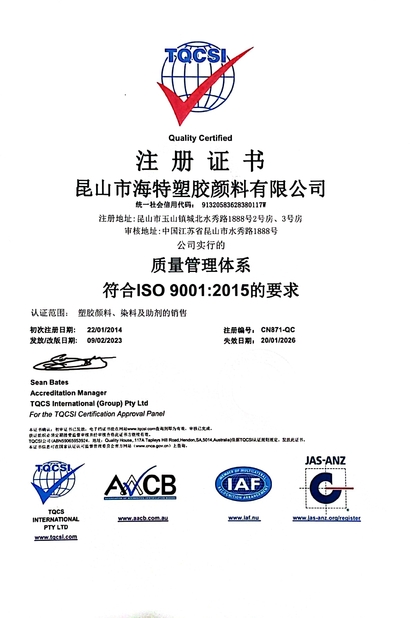
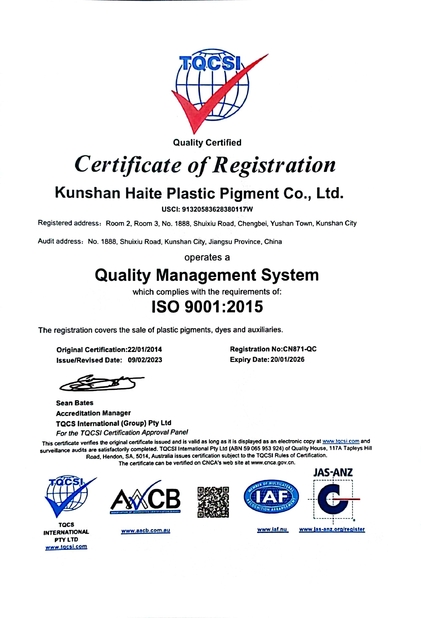
CHINA Kunshan Haite Plastic Pigment Co.,Ltd certificaciones
Comentarios de cliente
Probamos la muestra amarilla y comprobamos su estabilidad, y resulta ser mejor demasiado. Es conveniente para nuestra tinta del highlighter. Para este tinte fluorescente de la tinta, consideramos comprar un lote.

—— Hossein

Utilizamos el trazalíneas fluorescente de PTSA como trazalíneas en circuitos de agua así como nuestras sustancias químicas del tratamiento de aguas para supervisar cambios de la balanza de agua. Esta muestra es aprobada por nuestro técnico.

—— Parque

Envié un iquiry y recibo lo más pronto posible la contestación. Entonces hablamos por el teléfono de WhatsApp agradable. La orden está en procedimiento.

—— Jose

Vamos a fabricar los highlighters y a requerir 5 colores teñir para la pluma del highlighter. Después de la comunicación por la aprobación del teléfono y de la muestra, tenemos un requisito específico sobre el verde solvente 7.

—— Motiwala

Debido al lockdown, acabamos de comenzar a consumir el material pasado del lote. Publicaremos nueva orden una vez que la necesitamos. En junio, la esperanza everthing es mejor y viene como formal.

—— kim

Tenemos un negocio agradable con Kunshan Haite. Para el primer orden de compra, probamos las muestras después de receving las y su resultado era medida para arriba. Este producto se puede utilizar como agente del tratamiento de aguas en nuestro sistema en línea de la nube, así nos trae más eficacia. Es la segunda vez que hemos comprado de ellos. Espere cooperar en largo plazo.

—— Eram

Quisiéramos utilizar el verde solvente 7 al uso de las impresoras de chorro de tinta de Continuse en la industria para imprimir vencimiento y fabricar la fecha. Puede ser soluble en tinta.

—— Zain

El lote del azul solvente 36 que compré de Kunshan Haite está el mes pasado realmente disponible para nosotros. No influencia la propiedad química original de nuestro producto. Tiene realmente gran resisitance del calor. Cuento con los tintes solventes de la orden de otros colores después para más requisitos de clientes.

—— Tam

Soy un fabricante del antifreezer de coches en América. Necesito una clase de colorante soluble en agua como agente del trazalíneas. Cuando vi el verde solvente 7 de Haite. Entré en contacto con al comerciante de la exportación, y finalmente alcanzamos un acuerdo. Funcionamiento de las muestras el ‘está realmente bueno y disponible para nosotros.

—— KEN

Estoy en línea para chatear ahora
Compañía Blog
New Fluorescence Tech Enhances Industrial Cooling Efficiency
últimas noticias de la compañía sobre New Fluorescence Tech Enhances Industrial Cooling Efficiency

Chapter 1: The "Invisible Pain Points" and Management Challenges of Industrial Water Treatment

In modern industrial production, recirculating cooling water systems are often described as the "circulatory system" of manufacturing facilities. However, cooling water treatment has long operated as a "black box" management system. Maintenance personnel face extensive pipe networks, complex heat exchangers, and constantly changing makeup water quality.

Traditional management models typically rely on either "manual sampling + offline analysis" or "flow-proportional chemical dosing." These approaches suffer from three critical flaws:

  • Latency: Offline analysis creates delays of several hours or even days between sampling and results, leaving systems vulnerable to sudden water quality fluctuations.
  • Blind Operation: Flow-proportional dosing assumes ideal system conditions, ignoring variables like blowdown fluctuations, evaporation losses, and natural chemical degradation.
  • Cost Inefficiency: To mitigate scaling risks, operators often over-dose chemicals, leading to inflated costs and potential environmental contamination from excess treatment chemicals.

Chapter 2: PTSA – The "Digital Eye" for Cooling Water Treatment

PTSA (1,3,6,8-pyrenetetrasulfonic acid tetrasodium salt) serves as a molecular-level tracer with one defining characteristic: complete chemical inertness. It participates in no chemical reactions, resists bacterial degradation, and remains unaffected by oxidizing biocides. Functioning as a a "digital probe" within the system, it accurately reflects chemical retention levels as it circulates with the water flow.

Technical Characteristics of PTSA:

  • Exceptional Sensitivity: PTSA can be detected at parts-per-billion (ppb) concentrations, enabling comprehensive system monitoring with minimal additive quantities.
  • Unique Fluorescence Signature: Under specific wavelength excitation, PTSA emits distinctive fluorescence that remains virtually interference-free from common water impurities, ensuring data integrity.

Chapter 3: From Experience-Based to Closed-Loop Control Systems

To maximize PTSA's potential requires implementing a complete closed-loop control architecture:

  1. Smart Sensing Layer: Solid-state fluorescence sensors with self-cleaning capabilities continuously monitor fluorescence intensity in water samples.
  2. Data Analysis Layer: Controllers convert fluorescence signals into precise chemical concentration values, comparing them against predefined target concentration curves.
  3. Execution Control Layer: When concentrations fall below thresholds, controllers automatically activate chemical feed pumps, switching to maintenance mode when optimal levels are achieved. This "real-time response" approach achieves dosing accuracy exceeding 95%.

Chapter 4: Implementation Considerations and Practical Challenges

Despite PTSA's technological maturity, industrial applications require attention to several critical factors:

  • Biocide Interference Mitigation: Certain quaternary ammonium biocides exhibit fluorescence quenching effects. During their application, systems should switch to "time-lock mode," resuming fluorescence monitoring only after complete dispersion.
  • Turbidity and Color Compensation: In high-turbidity systems, suspended solids scatter excitation light. Instruments must incorporate "dual-wavelength compensation" technology to subtract background interference.
  • Storage and Preparation Protocols: PTSA requires light-protected storage. Manufacturing processes must maintain strict temperature controls to prevent hydrolysis in alkaline conditions, ensuring tracer purity.

Chapter 5: Industry Trends – The Path Toward Smart Water Management

With global carbon neutrality initiatives advancing, industrial water conservation has become a critical ESG metric. PTSA technology represents more than cost reduction—it enables "demand-based dosing" as a sustainable manufacturing practice. Future integration with IoT platforms will facilitate cloud-based data analysis, offering comprehensive lifecycle optimization for water treatment systems.

Conclusion: In an industrial environment rife with variables, PTSA introduces measurable certainty to cooling water treatment. By transforming complex chemical management into quantifiable data streams, it liberates maintenance teams from routine testing burdens, redirecting focus toward system optimization. This advancement represents not merely technological progress, but a fundamental shift in industrial water treatment philosophy.

Tiempo del Pub : 2026-10-08 00:00:00 >> Blog list
Contacto
Kunshan Haite Plastic Pigment Co.,Ltd

Persona de Contacto: Ms. Chai

Teléfono: 18001549185

Fax: 86-0512-5779-6655

Envíe su pregunta directamente a nosotros (0 / 3000)